Field note · 1 August 2026
Soccer jersey printing at events
Soccer crowds are the most demanding jersey line we run, and it is not the fabric. It is the clock. Everything a football audience wants from a personalization station happens inside two narrow windows, and if the line is not built for that shape it will fail in the middle of the best hour of the day.
Shape
Two surges and a long dead patch
Plot the demand curve at a watch party or a match-day fan zone and it is never flat. There is a hard spike from the moment gates open to roughly ten minutes before kickoff, near-total silence for forty-five minutes, a second spike at half time that is shorter and sharper than the first, and then a slow trickle that dies the moment the match becomes interesting again.
That shape breaks the standard way of sizing a station. Take a six-hour event with a four-hundred-jersey target, divide it out, and you get a number that looks comfortable and is completely wrong — because three hundred of those four hundred guests want their jersey in two windows totalling about ninety minutes.
So we size soccer lines against the peak, not the average. That usually means more lanes than the total would suggest, and it means the pre-kickoff window is where the whole event is won or lost. A station that is still working through the first surge when the match starts has effectively closed, because nobody is leaving their seat.
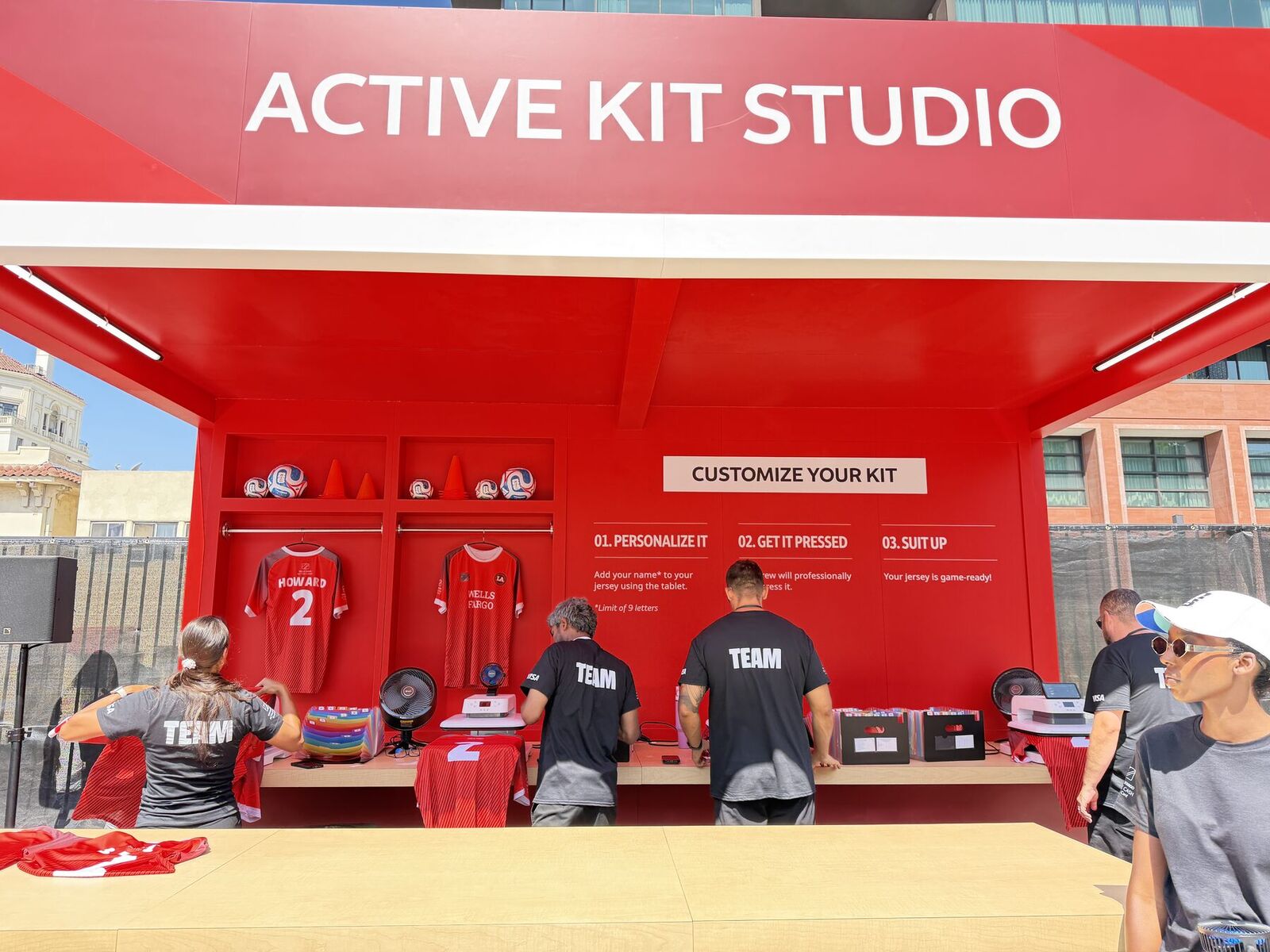
Two things buy back most of the peak. Pre-collected names from an RSVP or supporters' club list get gang-printed before the event, converting a print-and-press into a pick-and-press. And text-when-ready on premium tiers pulls bodies out of a physical queue that nobody wants to stand in when the teams are warming up.
Layout
The back of a soccer shirt is crowded
Compared to an American football cut, a soccer back is a small, busy canvas, and quite a lot of it is already spoken for.
The convention is name above number, both centred, with the name sitting in a band below the collar and the number occupying the mid-back. On replica and supporter shirts there is frequently a sponsor bar across the upper back or a printed panel that has to be cleared. The usable field between the collar band and the hem seam is often shorter than people assume, which caps the numeral height before any aesthetic decision is made.
Practical numbers we work to: name text runs roughly 2–2.5 inches tall and the number lands around 8–10 inches, tightened when a sponsor bar eats the top of the field. Numerals go on the centre seam, not on the visual centre of the panel — those differ on a cut with contrast side panels, and the seam is what the eye reads as centre on a body.
Side ventilation panels are the other constraint worth knowing. A wide numeral on a slim cut can run into a contrast panel or a mesh insert at the edge. On those garments a slightly condensed numeral face reads better than a standard one squeezed onto a narrower field.
Names
Nine characters, and the accent question
Soccer audiences write longer names than any other crowd we serve. They want their own surname, a player's surname, a nickname, a city, or the name of a supporters' club. The practical cap is about nine characters, and on soccer nights it gets tested more than anywhere else.
The reason is geometric rather than technical. A soccer back is narrow and the name sits in a shallow band. Past nine characters the letters either shrink until they stop reading as a shirt name and start reading as a label, or the tracking collapses and the word turns into a single dark bar from any distance. We would rather show the guest that on the tablet before they commit than hand them a jersey they are quietly disappointed by.
Diacritics are the second thing to settle in advance. An international crowd will type accented characters, and whether they render depends entirely on whether the numeral and lettering face you have chosen carries those glyphs. If your creative team picks a custom face, we check the character set before the event rather than discovering at 7pm that one guest's name is going to appear with a box in it.
The third is the profanity and content filter. A public, guest-typed personalization station needs a blocklist and a human at the tablet who can decline. This is a five-minute conversation at planning and a very unpleasant photo if skipped.
Kit
Fabric, sizes and family crowds
Soccer replicas are usually lightweight polyester with sublimated panels and ventilated mesh zones — which puts them squarely in the fabric conversation covered in what kind of jerseys we can print on. Saturated reds and navies need a test press and a migration-resistant film. Supplied club kit gets the same treatment, on a garment from the real run.
Size curve is the other soccer-specific note. Watch parties and fan zones draw families, not athletes, and they draw them across a wider age range than a corporate activation. Adult XS–3XL is the standard spread and youth cuts are worth carrying if the event is family-facing. Capping quantities per size in intake means a sold-out large disappears from the picker instead of becoming a conversation at the counter during the busiest ten minutes of the night.
If you are planning a match-day footprint, game day and fan fests covers the venue side and jersey printing turnaround times covers the throughput math in detail.
Planning a match-day station?
Send kickoff, gates, expected attendance and whether you own the kit. Names and numbers service · Send the brief