Field notes
Notes from the jersey line
Practical writing from a crew that runs these stations. Equipment and venue requirements, decoration methods that survive polyester, and how to tell a real jersey printing operation from a rented press.
Reading
Six from the crew
- What you need to print jerseys at your eventSize Runs and Roster Collection
- What you need to print jerseys at your eventPower, space, staging and the venue conversations to have four weeks out.
- DTF vs twill numbers on event jerseysWhy press application wins on a live line, and when twill or embroidery is still right.
- Choosing a jersey printing companyNine questions that separate an operation from a press and a folding table.
- Soccer jersey printing at eventsThe kickoff and half-time surge, a crowded shirt back, and names that run long.
- Basketball and football jersey numbersSizing, placement and legibility on tanks, wide backs and curved shoulders.
- Jersey printing turnaround timesThree clocks: the per-jersey cycle, the guest's wait, and pre-event lead time.
Want the operational overview instead? Line setup covers roles, equipment and the load-in sequence, and names and numbers is the service itself. Answers handles speed, cost, fabrics, durability and client-supplied garments.
Why we write these
The gap between a press and a production line
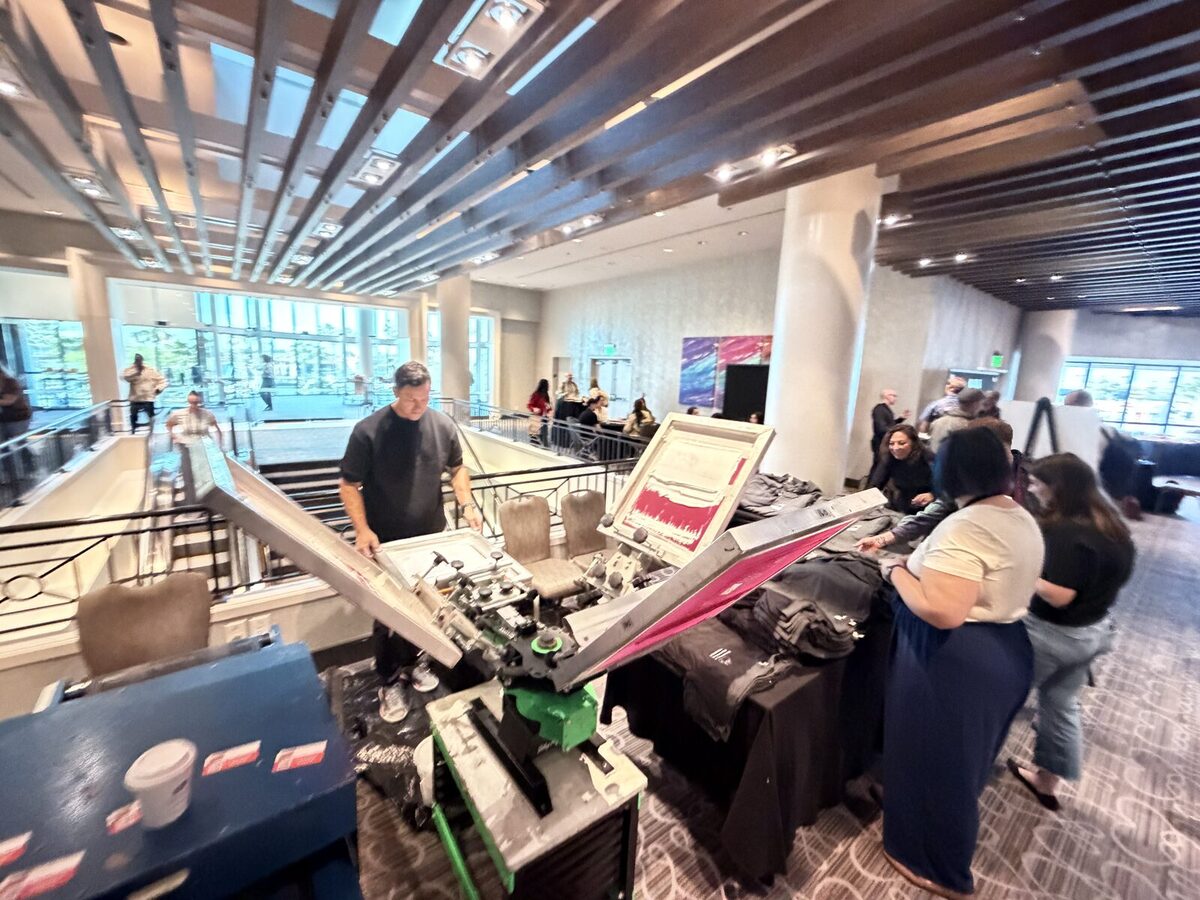
Most of what is written about event printing is written by people selling equipment. It describes what a heat press can do in a quiet room with one garment on the platen. That is not the job. The job is three hundred guests, a fixed window, a venue with opinions about your power cable, and a name that turns out to be eleven characters long.
So these notes cover the parts that decide whether a jersey station works: the venue conversations worth having a month out, the difference between decoration methods once polyester is involved, and the questions that tell you whether the crew you are about to book has actually run a queue before.
None of it is theoretical. Every constraint described here — the nine-character name cap, the dedicated circuit per lane, the reason a blank runner buys more throughput than a fourth press — came out of running the line, not out of a brochure.
Recurring themes
Four ideas that show up in everything here
Lanes, not machines
Capacity is a press plus an operator. Counting presses without counting people produces a number that will not survive a real Saturday.
The queue is the product
Guests do not experience throughput, they experience waiting. Ticketing, least-pending-work distribution and text-when-ready solve a different problem than adding capacity does.
Fabric decides the method
Jersey polyester is not a t-shirt. It rules out some techniques entirely and demands per-fabric press recipes for the ones that remain.
Constraints belong up front
Nine characters, one to three digits, sizes that can sell out. Every one of those is fine when the guest learns it before they commit and annoying when they learn it after.
Those four ideas are why our quotes look the way they do. When we come back with a lane count rather than a machine count, or ask for your run of show rather than a headcount, it is because the alternative produces a number that falls apart on the day. A planner who understands the reasoning can push back on it usefully, which is a better conversation than a quote nobody can interrogate.
Have a question we have not written up?
Ask it directly — (562) 614-4800 or contact@merchtroop.com. If it comes up twice it usually ends up here.