Answer
What kind of jerseys can you print on?
Short version: nearly all of them. Longer version, and the one that actually helps you plan — every jersey fabric wants its own press recipe, a couple of them want a conversation before you order four hundred of anything, and one or two are worth talking us out of.
Families
The five fabrics that show up
Polyester mesh. The classic athletic jersey knit, from tight micro-mesh through wide-hole practice mesh. It presses well as long as pressure is right: the adhesive has to reach into the knuckles of the knit rather than skim the surface. Micro-mesh behaves almost like a flat knit. Very open mesh is the one place we push for a heavier transfer stock, or twill numerals applied before the event.
Tricot and dazzle. Slick, shiny, warp-knit polyester — basketball and football replica territory. It takes a transfer cleanly and holds a crisp edge, which is why numerals look sharpest on it. The catch is that slick faces show every alignment error, so a numeral a centimetre off the centre seam is obvious from ten feet away.
Dye-sublimated stock. Panels, gradients and sponsor blocks printed into the fibre rather than onto it. Prints beautifully, behaves unpredictably under heat. See the next section.
Cotton-poly blends. Fan jerseys, baseball-cut tees and the softer replica shirts an audience actually wears in July. The easiest fabric on this list. Higher cotton content tolerates more heat and gives you a wider window on dwell.
Garments that already carry twill. A supplied kit with a stitched crest or sponsor bar is fine to work with. We press around the existing decoration and set the numeral position relative to what is already on the garment, not to a generic template.
Heat
Sublimated jerseys and the haze problem
This is the single most useful thing on this page. Sublimation dye is not sitting on the fabric — it is inside the fibre, and it went in with heat. Apply heat again and some of it wants to move again.
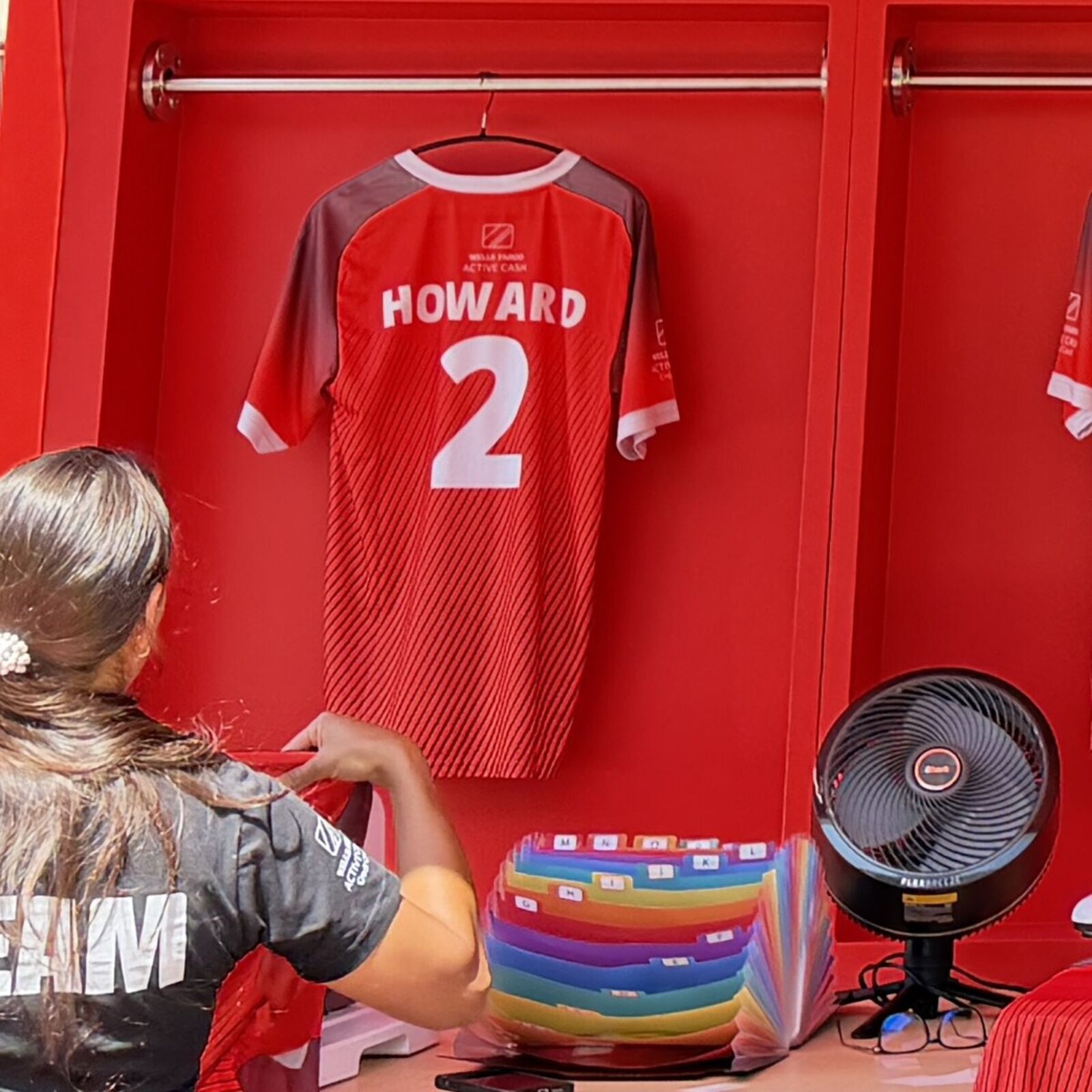
What that looks like in practice: you press a white numeral onto a deep red sublimated jersey, everything looks perfect on the platen, and twenty minutes later there is a faint pink cast bleeding through the white. That is dye migration, and it is not a defect in the transfer. It is the garment doing exactly what it was manufactured to do.
We manage it three ways. First, a lower press temperature with a longer dwell, which gets the adhesive to flow without waking the dye up. Second, blocker-grade transfer film with an opaque white base built to resist migration. Third — the one nobody can skip — a test press on a garment from your actual production run, not a similar garment, done before the first guest arrives.
Deep reds, navies and purples are the usual offenders. Blacks and light colours are generally uneventful. If your kit is a saturated red sublimated replica, tell us at the quote stage and send us one so we can burn a test on it early rather than discovering it at load-in.
Caution
What we will talk you out of
- Water-repellent or heavily coated shells. A DWR finish is engineered to stop liquids bonding to the face of the fabric. Adhesive is a liquid at press temperature. Warm-up jackets and shells are a pre-event decoration job, not a live line.
- Anything with a seam, zip or thick side panel inside the print area. The platen needs a flat field. A raised seam under the numeral produces an uneven bond that fails first at exactly that ridge. Sleeve numbers on a heavily panelled cut usually want a small platen and a different position.
- Ultra-lightweight recycled knits with very low melt tolerance. Some sustainability-focused fabrics scorch or glaze at temperatures that other polyester shrugs off. They are still workable, but they narrow the recipe window, so they need testing rather than assuming.
- Fabric that arrived with a softener finish. Silicone softeners are the quiet cause of adhesion failure on supplied garments. If a kit was laundered before it reached you, we need to know.
None of that is a refusal. It is the difference between a line that runs and a line that produces two hundred jerseys with a problem that surfaces after the guests have gone home. More on that in whether printed names and numbers crack or peel.
Blanks
What we bring if you are not supplying kit
Augusta Sportswear and Badger cover the bulk of blank jersey requirements — mesh, tricot, dazzle and lighter performance cuts, adult XS through 3XL, in the colour ranges most activations need. They are reliable under a press, consistent between production lots, and available in quantity, which matters more than it sounds when you need three hundred of one colour on a fixed date.
If your footprint mixes jerseys with other garments, the same crew brings Bella+Canvas 3001 and Gildan for tees and Richardson 112 or Flexfit for the hat side. Building the size curve is a separate conversation and a genuinely important one — corporate and family crowds skew larger than planners expect, and sizes can be capped in intake so a sold-out large disappears from the guest picker rather than being promised and withdrawn.
Supplying your own kit is equally common and often the cheaper path. What we test and what we need alongside the garments is covered in can you print names on jerseys we already own.
Not sure what your fabric will do?
Send a garment or a spec sheet and we will tell you honestly. Names and numbers service · DTF vs twill · Send the brief