Field note · 1 August 2026
Jersey printing turnaround times
There are three clocks running at a jersey station and planners usually only ask about one of them. There is how long one jersey takes, how long a guest waits, and how long the lead time is before the event even happens. They are related but they are not the same number, and confusing them is how a station ends up under-built.
Clock one
The per-jersey cycle, broken apart
A single personalized jersey is a short, repeatable sequence, and it is useful to see where the time actually sits:
- Intake. Greet, explain the character cap, take the name and number, confirm size against live inventory, submit. Fast when the options menu is short, slow when it is a catalogue.
- Transfer. Either produced live from the guest's entry, or already sitting in a sorted stack because the name was pre-collected. This is the single biggest swing in the whole cycle.
- Retrieval. Pull the correct blank in the correct size and colour. Should be an arm's reach. If it is a walk, you have converted press time into walking time.
- Position. Lay flat, align name arc and numeral to the centre seam, tape if needed. Slower on tanks and shoulder placements.
- Press. Ten to fifteen seconds of dwell for most jersey fabric. Fixed, and small.
- Peel, inspect, fold. Timed to the film. Inspection is not optional.
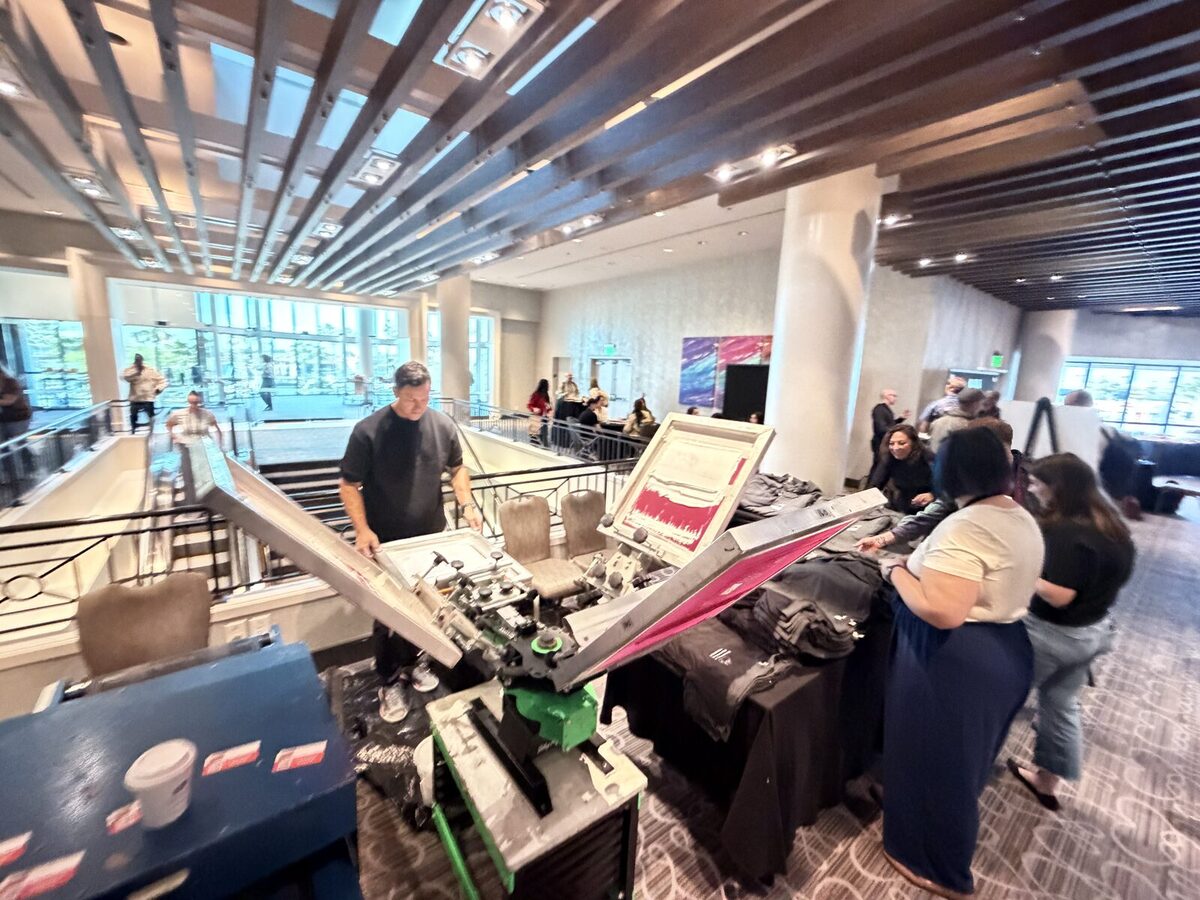
Notice that the press itself — the machine everybody pictures — is a small slice. The cycle is dominated by handling. That is why buying another press without another operator buys nothing, and why a blank runner on a three-lane build is usually worth more than a fourth lane.
Clock two
What the guest experiences
Guests do not experience cycle time. They experience the queue in front of them, and those are different problems with different fixes.
Tablet intake turns each guest into a numbered ticket. Tickets go to lanes by least-pending-work rather than strict rotation, so a lane that catches a fussy job does not accumulate a backlog while the lane beside it stands idle. Staff work a queue board showing what is pending, what is on a press and what is at handoff.
That visibility is what makes the three mid-event levers possible. The supervisor can open another lane. They can cap the queue, so no ticket is accepted that cannot clear before close — far better than accepting work you will have to apologise for later. Or they can switch premium tiers to text-when-ready, which does not raise throughput at all but removes the physical line, which is frequently the real objective.
The honest framing for a planner: adding capacity changes how many jerseys get made, and queue management changes how the event feels. Most stations that "felt slow" were producing fine and managing the wait badly.
Slow
Six things that make a line drag
- An options menu that grew. Three colours and two print locations is a fast counter. Eight colours, four locations and a design gallery is a slow one before a single press has closed. Every extra decision at the tablet is paid for by everyone standing behind that guest.
- Walk-up names with no pre-collection. Producing a transfer live is a genuinely different cycle from picking a pre-printed one.
- Bad layout. Intake, presses and handoff on the same two metres of counter means staff crossing each other all day.
- Unstaged blanks. If nobody has pre-sorted by size and colour, every jersey includes a search.
- Shoulder and sleeve placements on the guest menu. Curved-surface placements cost roughly another jersey's worth of time each.
- One circuit shared between lanes. A tripped breaker is not slow, it is stopped. Plan a dedicated 20A circuit per lane.
Five of those six are settled at planning, not on the day. That is the point of asking about them early.
Clock three
Lead time before the event
The pre-event turnaround is the one that quietly kills projects. Four weeks out is comfortable: art proofed, numeral face chosen, options menu locked, blanks ordered against a real size curve, power sheet with the venue. Two weeks is workable if you are supplying garments and the artwork is settled. Inside a week the constraint is nearly always blank availability in the sizes and colour you want, not our capacity.
Pre-collected names deserve their own deadline. If rosters or RSVP names are landing with us at least several days out, they get gang-printed and sorted before load-in, and those guests become a pick-and-press. A roster that arrives the night before is a roster that gets treated as walk-up.
Plan against the peak, not the average. A six-hour event with a four-hundred-jersey target is not sixty-seven jerseys an hour if three hundred of those guests arrive in two windows. Send us your run of show and we size the lanes against the busiest ninety minutes.
For the lane math itself, how fast can you print jerseys at an event covers how we build the estimate, and the names and numbers service page covers what is actually included. Venue-side requirements are in what you need to print jerseys at your event.
Want a real throughput estimate?
Send hours, run of show, jersey target and garment source. Pricing inputs · Send the brief