Line setup
How we build a live jersey printing line
A jersey station is a small factory that has to look like hospitality. This page is the operating detail behind it — the roles, the equipment, the load-in order and the decisions we need settled before a truck leaves Orange County. For the service itself, see names and numbers.
Roles
Who is standing where
Tablet intake
One or two staff own the tablets. They greet, explain the nine-character cap before the guest types, confirm size availability against live inventory, and submit the ticket. Good intake is the difference between a line that moves and a line that argues.
Press operators
One operator per press, full stop. They pull the staged blank, align the name arc and numeral to the jersey's centre seam, press to the recipe for that fabric, peel, and inspect. They do not leave the lane to find a garment.
Blank runner
On three- and four-lane builds a runner keeps every press stocked by size and color and rotates stock out of cases. This single role is usually worth more throughput than adding a fourth press.
Pickup and fold
Finished jerseys get folded or hung and matched to ticket numbers. On premium tiers this is also where the text-when-ready system lives, so guests browse the rest of your event instead of standing in a queue.
Equipment
What comes off the truck
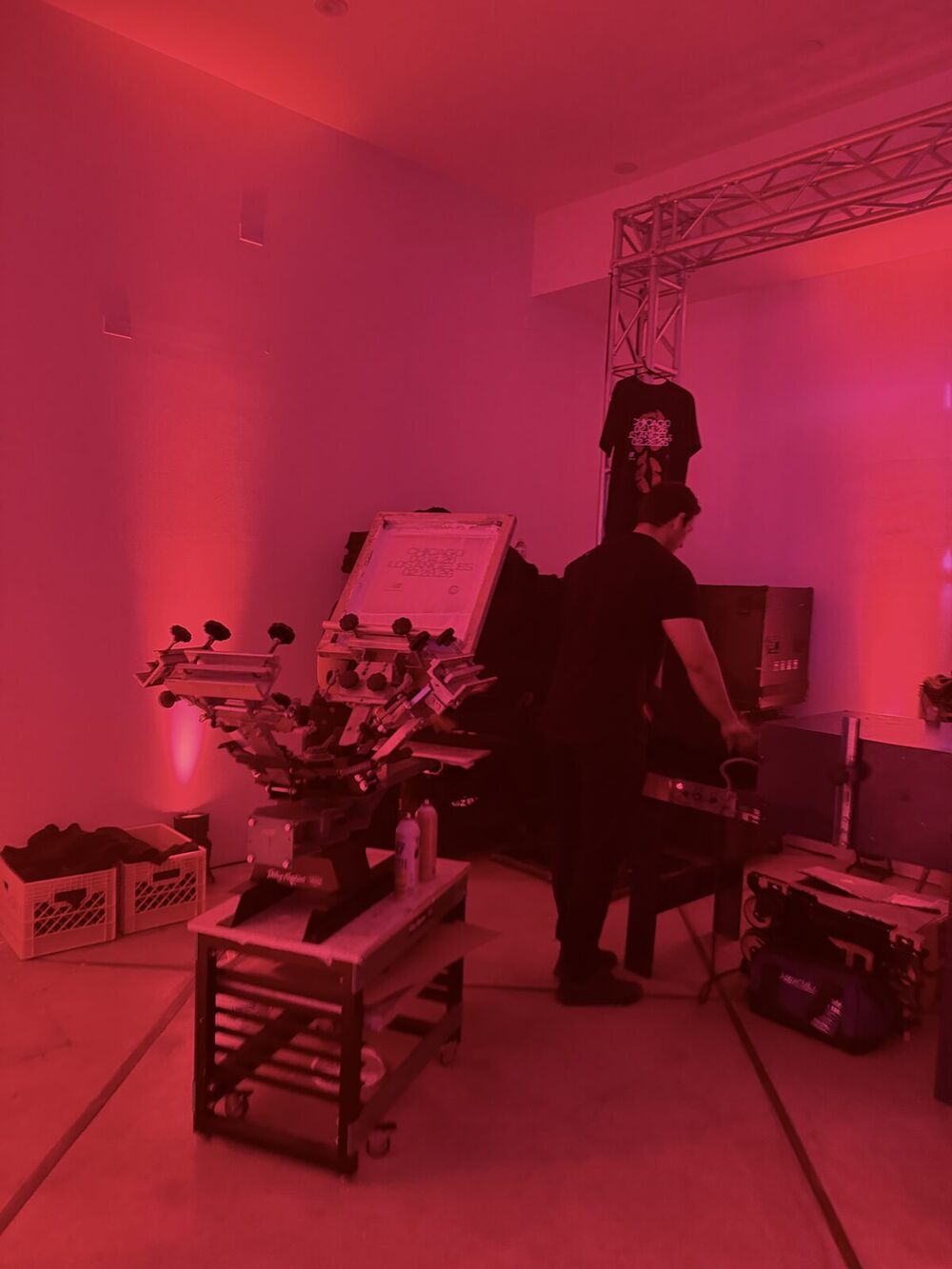
Every lane travels as a kit: press, spare platens for sleeves and youth cuts, heat tape, a lint roller, a heat gun for stubborn peels, and the transfer stock for that event. We bring at least one spare press on multi-lane builds, because a dead press on a four-hour activation is not a repairable problem — it is a capacity problem.
Transfers are produced in advance and sorted. Names that were pre-collected (team rosters, RSVP lists, VIP lists) get gang-printed before the event, so those guests are effectively a pick-and-press rather than a print-and-press. Walk-up names are produced on site.
Power, honestly
Heat presses pull real current. Plan a dedicated 20A circuit per lane. Sharing a single household circuit across two presses will trip a breaker at exactly the worst moment. We send a power and space sheet you can forward straight to the venue's operations contact, and we would rather have that conversation four weeks out than at 6am load-in.
Space and layout
A two-lane build is comfortable in roughly a 10x10 footprint if pickup is on the same counter; three or four lanes want a 10x20 or an L. What matters more than raw square footage is the traffic pattern: guests should approach intake, move sideways, and collect at a separate point, so nobody is standing in front of the presses watching heat elements.
Garments
Blanks we bring, or the kit you already own
Two paths, and they price very differently.
We source the blanks. Augusta Sportswear and Badger cover the bulk of blank jersey needs — mesh, tricot, dazzle, and lighter performance cuts in adult XS through 3XL. We build the size curve with you, cap quantities per size in the intake system, and stage them by size before doors so retrieval is instant. If your activation mixes jerseys with tees or caps, Bella+Canvas 3001 and Gildan handle tees and Richardson 112 or Flexfit handle the hat side.
You supply the jerseys. Extremely common with teams, leagues and sponsors who already have kit sitting in a warehouse. We take a sample from your actual run and test press settings on it before we touch a single guest garment, because a sublimated panel or an unusual coating will behave differently than the spec sheet claims — see what kind of jerseys we can print on for how each fabric behaves. Then we personalize what you own and hand it back. You pay for the crew, the transfers and the logistics — not for garments you already bought.
The size question nobody asks early enough
Guest-facing events run adult XS–3XL. The most common planning mistake is ordering a bell curve that assumes an athletic crowd. Corporate and family audiences skew larger than planners expect, and a station that runs out of XL two hours in reads as poor planning even if you gave away four hundred jerseys. Caps per size in the intake system are the safety net, but they do not replace a realistic curve.
Sequence
Load-in to last jersey
Four weeks out
Lock hours, jersey count, garment source, options menu and the numeral font. Art files proofed. Power sheet to the venue.
Load-in
Presses positioned, circuits confirmed, tablets synced, blanks unpacked and sorted by size, test press on a sacrificial garment from the real run.
Doors
Intake opens, queue board live. Supervisor watches pending-per-lane and pulls the levers: add a lane, cap the queue, or switch VIPs to text-when-ready.
Close and out
Last ticket cleared, remaining blanks counted and packed, presses cooled and cased. Setup and teardown hours are quoted up front, never billed as a surprise.
One more service note
Jersey work leads here, but the crew that shows up is a full live-merch operation: live DTF heat pressing, screen printing, embroidery, hat bar with patch application, laser engraving and UV DTF stickers. If your footprint has room for a second station, it usually costs less to add it to an existing crew than to book it separately. See what drives the number.