Answer
How fast can you print jerseys at an event?
Fast enough that guests wait rather than leave — and the honest way to answer this is with your numbers, not ours. Throughput on a live jersey line is set by lane count and by the four or five things that decide how smoothly each lane runs. Here is exactly how we work it out.
The unit
A lane, not a press
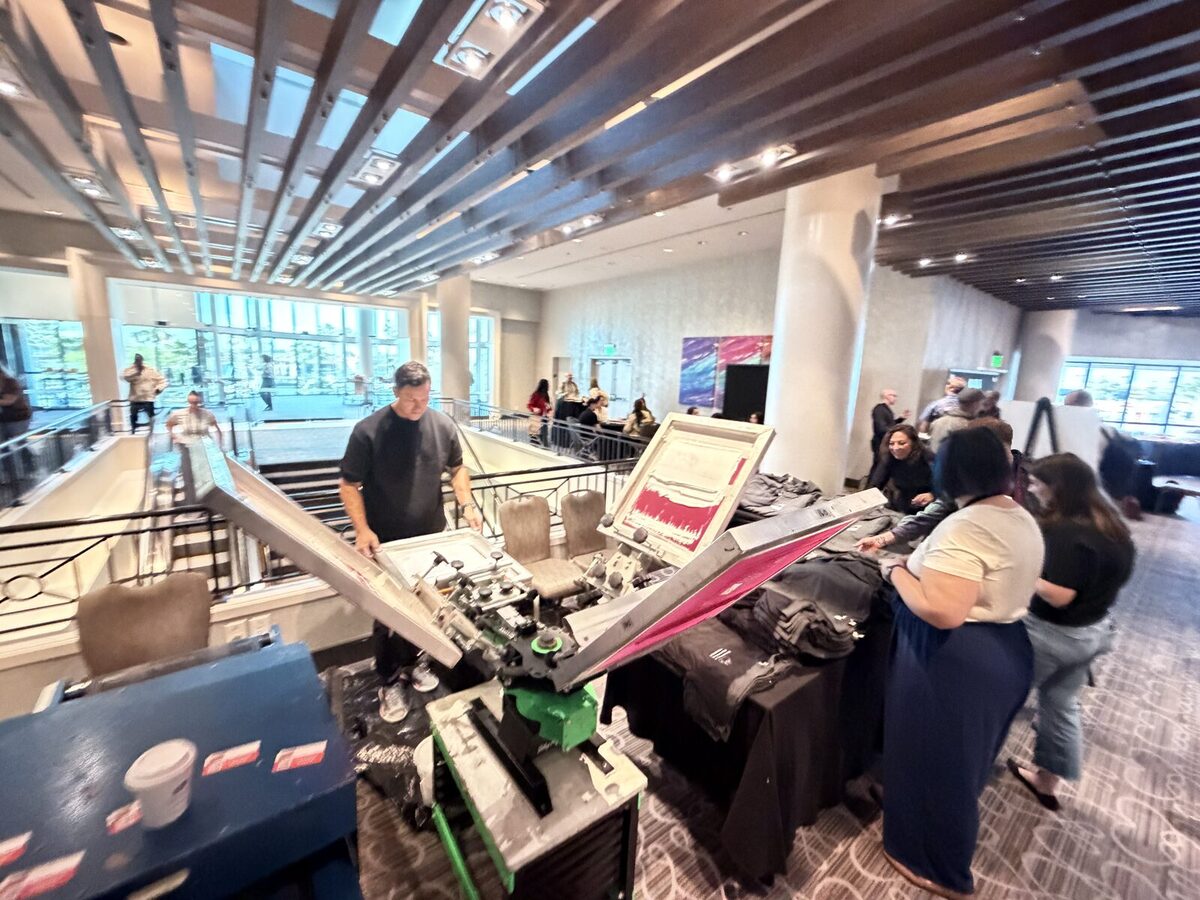
One press plus one operator equals one lane. That pairing is the unit of capacity, and it is why we quote lanes instead of machines. A second press with no second operator adds nothing.
Each personalized jersey is the same short cycle: pull the staged blank, lay it flat on the platen, align the name arc and the numeral against the centre seam, press to the recipe for that fabric, peel, inspect, fold. A trained operator repeats that steadily for hours. The press is almost never the limiting factor.
Events commonly run two to four lanes. Two is the working minimum for a public-facing line, because one lane has no redundancy — a single fussy job stops everything. Large activations scale past four, with dedicated intake, a folding and handoff table, and a runner keeping blanks staged.
Variables
Why we will not publish one number
Any company that gives you a jerseys-per-hour figure without asking about your event is quoting a best case from a different event. These are the things that move it, and they move it a lot:
- Walk-up versus known names. Pre-collected names get gang-printed in advance and become pick-and-press. That is a different cycle from producing a transfer live.
- Options menu width. Three colors and two print locations is a fast counter. Eight colors, four locations and a design menu is a slow one, before a single press closes.
- Fabric. A mesh training top and a sublimated replica take different recipes and different dwell times.
- Layout. If an operator walks to fetch a blank, you have converted press time into walking time.
- Demand shape. A flat eight-hour trade show and a ninety-minute pre-match window need completely different lane counts for the same total.
Send us those and you get a number we will stand behind on the day.
Queue
Perceived speed is a different problem
Guests do not experience throughput. They experience waiting. Those are different problems and they have different fixes.
Tablet intake turns every guest into a numbered ticket, and tickets go to lanes by least-pending-work rather than in strict rotation. One lane hitting a slow job does not build a backlog while the lane beside it idles. Staff work a queue board that shows what is pending, what is on a press and what is at handoff.
From there the supervisor has three levers mid-event: open another lane, cap the queue so nothing is accepted that cannot clear before close, or switch premium tiers to text-when-ready so those guests circulate and come back when their jersey is up. That last one does not increase throughput at all — it just removes the line, which is frequently the actual goal.
For the cycle broken into its parts, and the pre-event lead times that decide whether pre-collection is even possible, see jersey printing turnaround times.
Get your number
Send hours, jersey target, garment source and whether names are known. We will come back with lane count and a throughput estimate. Send the brief · Turnaround times · Pricing inputs